Wayground vs Gimkit: Which Should You Use?
The short answer: pick Gimkit for strategy-economy gameplay that older students love, and pick Wayground (formerly Quizizz) for self-paced homework, a bigger question library, and detailed reports. One more thing up front: Gimkit’s free plan is the more restrictive of the two, which matters if you’re not planning to pay.
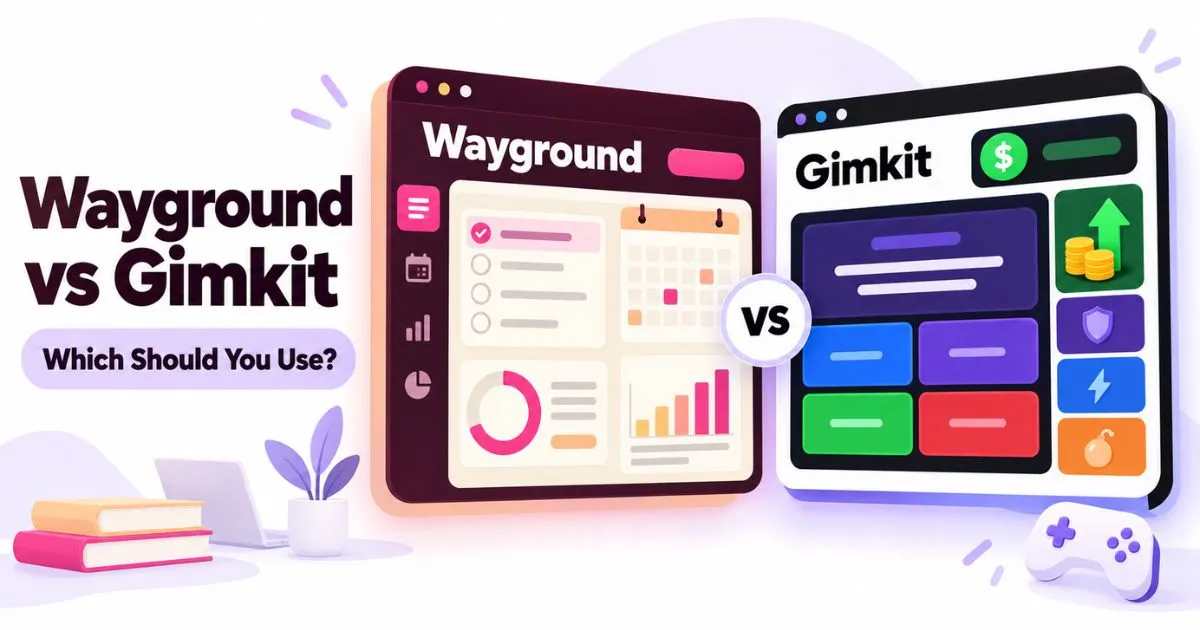
Both make quizzes feel like games, but Gimkit turns answering into a strategy game, while Wayground keeps the focus on practice and data. Here’s the full comparison.
Quick comparison
| Wayground (formerly Quizizz) | Gimkit | |
|---|---|---|
| Main draw | Self-paced practice, big question library, reports | In-game economy and strategy modes |
| Best for | Homework, assessment, mixed ages | Strategy-loving older students |
| Game style | Quiz play with memes and leaderboards | Earn cash, buy upgrades, 2D game modes |
| Free plan | Generous | More limited (best modes need Pro) |
| Homework | Core feature, flexible | Available, stronger on live play |
| Reports | Detailed per-student and mastery | Decent, not as deep |
| Question library | Very large teacher library | Smaller, mode-focused |
The core difference: strategy economy vs straight practice
Here’s what actually sets Gimkit apart from everything else.
In Gimkit, answering questions earns virtual money, and students spend or invest that money on upgrades and power-ups. Correct answers fund strategy, so students are making decisions beyond just picking the right option. Its 2D modes push this further by dropping students into interactive worlds. That economic layer is Gimkit’s whole identity, and older students in particular get hooked on it.
In Wayground, the quiz is the experience. There are leaderboards, memes, and timers, but no economy to manage. Students answer, get instant feedback, and move on, and the teacher gets the data afterward. If you want a fuller overview of the platform, see our what is Wayground guide.
So the question is really: do you want students strategizing inside a game economy, or practicing and being measured on the content?
Game modes
Gimkit has a deep catalog of 2D game modes, like the fishing-economy mode Fishtopia, the winter battle Snowbrawl, the social-deduction Trust No One, and platformers where students climb while answering. There’s even a creative mode where teachers build custom maps. For sheer gameplay depth, Gimkit leads.
Wayground offers live and self-paced quiz play with leaderboards and power-ups, but it isn’t trying to be a 2D game engine. Its variety is in question types and content, not game worlds.
Free plans (read this before choosing)
This is a bigger deal than most comparisons admit. Gimkit’s free Basic plan is genuinely limited: only a few rotating game modes are free, and the most popular Pro-exclusive modes are capped at a handful of students unless you pay. For a full class relying on the best modes, the free tier gets frustrating fast.
Wayground’s free plan is more generous, covering self-paced play, homework, and core features for a normal class size. If budget is a constraint and you want the full experience without paying, Wayground is the safer pick.
Homework and self-paced work
Wayground is built for homework and self-paced practice, with flexible deadlines for revision students do on their own time. Gimkit can assign work too, but it’s strongest as a live, in-class strategy game. If independent practice is a regular part of your week, Wayground fits more naturally. Setup steps are in our host a game guide.
Reports and assessment
Wayground gives detailed per-student reports and mastery insights, plus a very large teacher-made question library and curriculum alignment. Gimkit’s analytics are decent but not as deep, since assessment isn’t its main job. For data-driven teaching, Wayground is ahead.
Age group and classroom fit
Gimkit tends to land best with high school and older middle school students, who enjoy the strategy and economy layer. Wayground works across a wider age range and suits any setup where structured practice and measurement matter more than gameplay depth.
Pricing
Both offer more with a paid plan, but the shape is different. Gimkit Pro runs around $14.99 a month or about $59.88 a year, and a 14-day Pro trial is available. Wayground keeps a free plan and offers paid individual tiers in a low monthly range, with heavier plans aimed at schools and districts. Prices change and vary by region, so check the official gimkit.com and wayground.com pricing pages before deciding.
So which should you choose?
Match it to your class:
- Choose Gimkit if your students are older, love strategy and the earn-and-upgrade loop, and you’re willing to pay Pro to unlock the best modes. Its gameplay depth is unmatched.
- Choose Wayground if you want self-paced homework, a big question library, detailed reports, a wider age range, or a more generous free plan. It’s the better all-round teaching tool.
If your priority is deep, strategic gameplay, Gimkit wins. If it’s practice, coverage, and data, Wayground does more.
Can you use both?
Yes. Gimkit for an in-class strategy game your older students will beg for, Wayground for homework, practice, and the reports that tell you what to reteach. You can also see how Wayground compares to Kahoot and Blooket.
Frequently asked questions
Is Wayground better than Gimkit?
Neither is better overall. Wayground is better for homework, question variety, and reports, and has a more generous free plan. Gimkit is better for strategy-economy gameplay and deep game modes.
Is Wayground the same as Quizizz?
Yes. Quizizz rebranded to Wayground in 2025, so this comparison applies to the same platform.
What makes Gimkit different?
Its in-game economy. Students earn virtual money for correct answers and invest it in upgrades, adding a strategy layer on top of the questions.
Is Gimkit free?
Gimkit has a free Basic plan, but it’s limited: many popular modes need Gimkit Pro, and Pro-exclusive modes are capped to a few students on the free tier.
Which is better for homework?
Wayground. Its self-paced homework mode is a core feature, while Gimkit is strongest as a live in-class game.