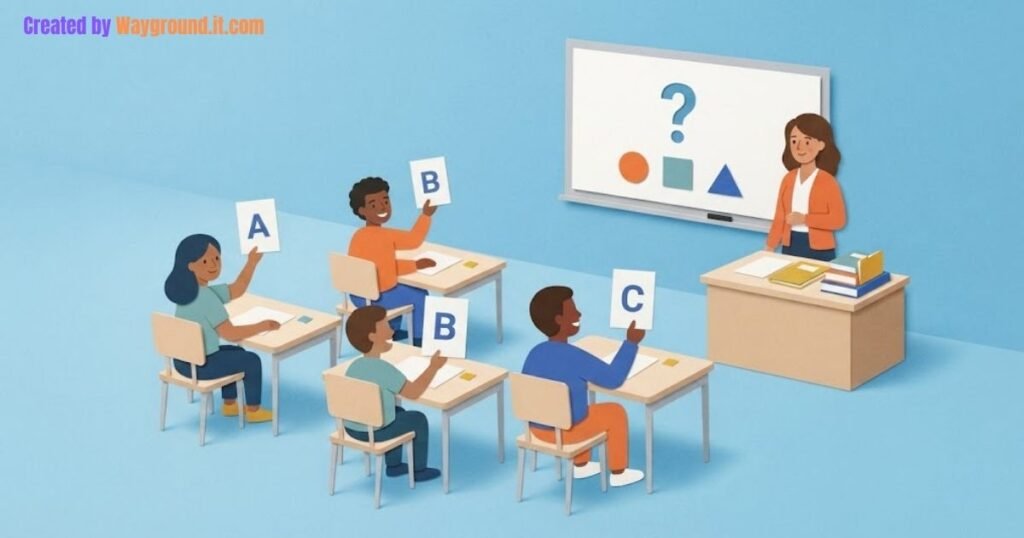

A hinge question is a short check at a decision point in a lesson: can students use the idea you just taught, or do they need another explanation? Every student responds before you continue. The answer choices should help you distinguish different misunderstandings, not simply count correct answers.
Below are three original classroom examples, with answer keys, possible interpretations, and follow-up questions. Adapt them to what your students have already learned.
What makes a hinge question different from a regular quiz?
A hinge question checks a prerequisite at the moment you need to decide what happens next. A regular quiz may assess several skills or produce a score. Here, one focused question should give you enough usable evidence to continue, clarify a particular idea, or pause the planned task.
In the Education Endowment Foundation’s guidance on diagnostic assessment, mathematics specialist Simon Cox describes multiple-choice checks whose incorrect options reflect misconceptions. That makes the options part of the assessment design, rather than filler around the right answer.
An exit ticket often helps you plan a later lesson; a hinge question informs the lesson still happening. Both can serve a formative purpose, as our formative vs summative assessment guide explains.
How do you write a question that reveals useful differences?
Start with the next classroom task and identify the idea students need to attempt it successfully. Write a question that isolates that idea. Then build plausible wrong options around specific errors, and decide what you will do if students select each one. Keep unrelated difficulty out of the task.
- Name the decision. “Can students interpret an exponent before evaluating longer expressions?” is more useful than “Do they understand today’s math?”
- Work out the wrong answers. Calculate or explain how a learner might reach each option. If you cannot identify a plausible route, replace it.
- Check for accidental clues. Remove options that look silly, grammatical mismatches, and wording that makes only the correct answer sound carefully written.
- Prepare a second question. After clarification, use different numbers or wording to check whether students can apply the idea independently.
Education researcher Dylan Wiliam’s hinge-question design guidance suggests allowing up to two minutes for responses and aiming to interpret them within 30 seconds. Treat that as a planning target, not a reason to rush students who need established accommodations.
What do hinge questions look like in different subjects?
The examples below pair a question with the teaching decision it supports. Each incorrect option has an intended interpretation, but a selected letter cannot prove what a student was thinking. Use the pattern to choose a follow-up, and ask for reasoning when the response could have several explanations.
1. Math: does an exponent mean repeated multiplication?
Use after: Introducing positive whole-number exponents, before evaluating expressions that contain them.
Ask: Which calculation has the same value as 2³?
- A. 2 × 3
- B. 2 × 2 × 2
- C. 3 × 3
- D. 2 + 3
Correct answer: B. The base, 2, appears as a factor three times, giving 8.
A suggests the student may be treating the exponent as a multiplier. C may indicate confusion about which number is the base and which tells you how many factors to use. D may reflect combining the two visible numbers through addition.
Teaching response: If A attracts several responses, write 2³ beside its expanded product and label the base and exponent. Contrast it with 2 × 3 rather than simply announcing that the answer is 8.
Fresh check: Ask students to write 4² as a multiplication expression. Look for 4 × 4, then ask for its value separately.
Choosing B alone does not show that students can handle negative bases or exponent laws. Keep the conclusion limited to the meaning tested here.
2. Science: does dissolved sugar still contribute mass?
Use after: Teaching that dissolving does not make matter disappear, before discussing evidence from a dissolving investigation.
Ask: A sealed jar contains water and 10 g of sugar that has not yet dissolved. The jar and everything inside it have a total mass of 250 g. After the sugar dissolves, with nothing entering or leaving, what is the total mass?
- A. 250 g
- B. 240 g
- C. 260 g
Correct answer: A. The sugar remains in the sealed jar as part of the solution.
B could indicate that a student subtracts the sugar because it is no longer visible. C could mean they add its mass again, overlooking that the initial total already included it.
Those interpretations call for different responses. For B, connect the particle model to the sugar’s continued presence; for C, underline what the first measurement includes.
Fresh check: Ask about 5 g of salt dissolving inside a sealed container whose initial total mass is 180 g. The total remains 180 g; ask students to explain why the stated conditions matter.
If you demonstrate this with a balance, discuss its measurement precision. A small reading difference is not evidence that dissolving destroyed matter.
3. English: which noun controls subject–verb agreement?
Use after: Identifying the main subject and an intervening prepositional phrase, before independent sentence editing.
Ask: Choose the correct verb and reason for this sentence: “The box of markers ___ beside the notebooks.”
- A. “Are,” because “markers” is plural.
- B. “Are,” because “notebooks” is plural.
- C. “Is,” because “box” is the main subject.
Correct answer: C. The singular subject “box” takes “is.”
A points toward agreement with the nearby noun inside “of markers.” B may indicate that the student looks for a plural noun anywhere in the sentence without identifying its role.
Teaching response: Temporarily bracket “of markers” and “beside the notebooks,” leaving “The box is.” Restore the phrases and show that neither changes the main subject.
Fresh check: Use “The boxes of chalk ___ beside the cabinet.” The answer is “are,” because the main subject is now plural.
How should you respond to the class’s answers?
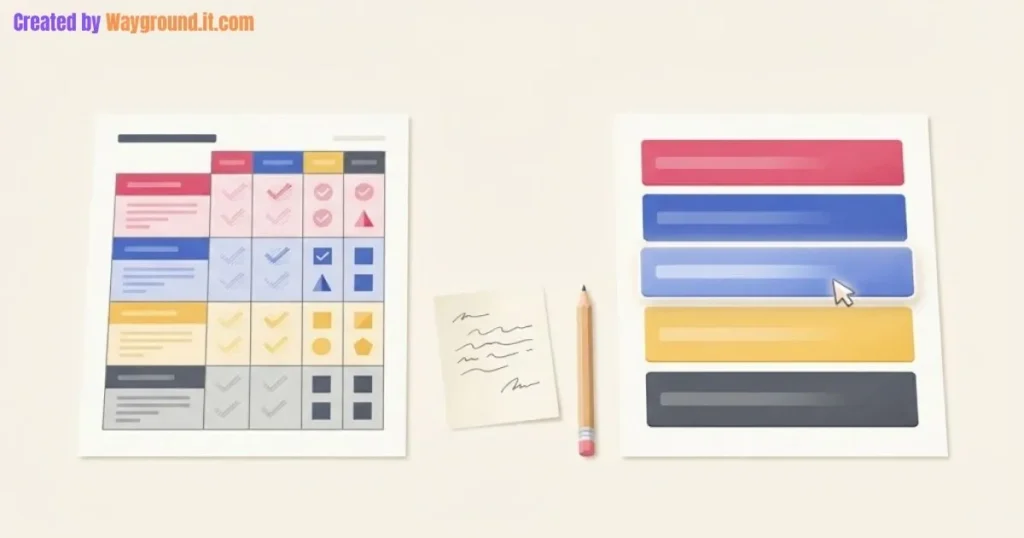
Read the distribution of choices before deciding what to teach next. A large group choosing the same wrong option needs a different response from scattered errors or missing answers. The table below is a planning aid; it does not set universal percentage thresholds or assign students permanent ability labels.
| Response pattern | Practical next move |
|---|---|
| Most responses are correct, with a few errors | Begin the next task and check in with the students whose answers need clarification. |
| Several students select the same wrong option | Address that option’s underlying idea, then use the prepared follow-up. |
| Wrong answers are spread across options | Check the wording and revisit the prerequisite before assuming one shared misconception. |
| Many students do not respond | Check visibility, reading demands, directions, and thinking time before interpreting understanding. |
| Responses become correct after a public explanation | Use a fresh independent item before concluding the idea is secure. |
A high correct-answer rate can still hide guessing or copying. Avoid using one response to make a consequential grading or placement decision.
How can you collect answers without disrupting the lesson?
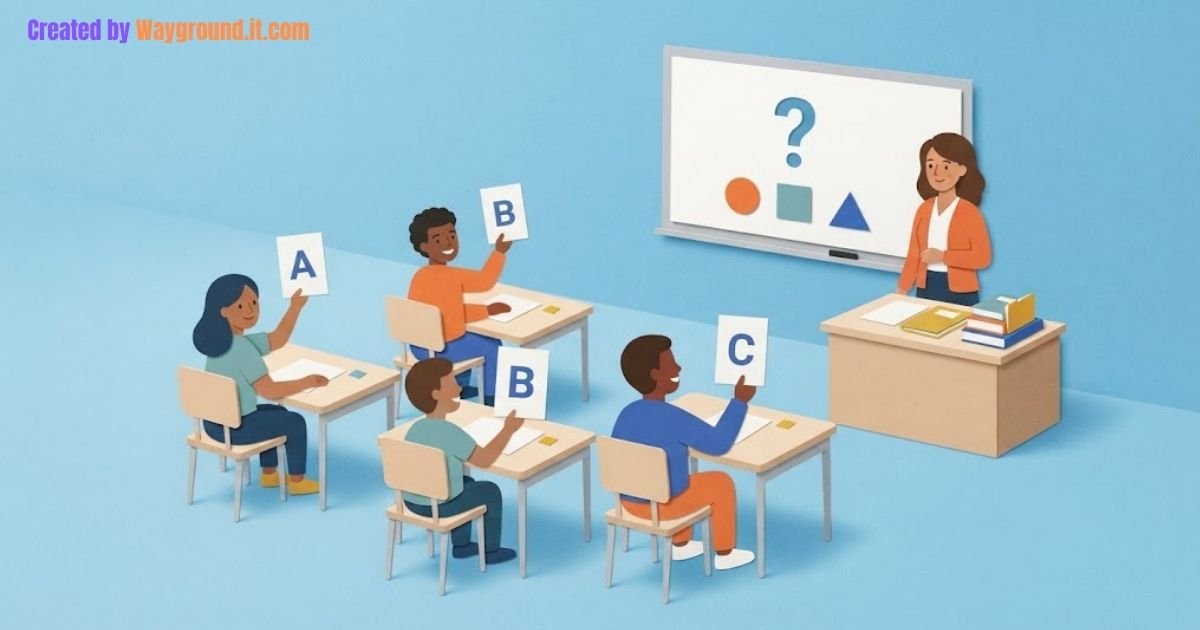
Choose a response method you can scan without turning the check into a separate activity. Students can write a letter on a mini whiteboard or use answer cards. Collect their first choices independently, then reveal or discuss the result once everyone has had a reasonable opportunity to respond.
Use letters as well as colors so the response does not depend on distinguishing shades. Make the question readable from every seat, and preserve individual access arrangements.
If you want to scan printed response cards, our Plickers setup guide covers that workflow. You do not need to introduce a new platform just to ask one question.
Keep the check low stakes. Students need to know that an incorrect answer helps determine the next explanation, rather than becoming a public ranking.
What should you prepare before your next lesson?
Prepare one question, its likely error patterns, and the follow-up you will use after clarification. Choose a point where the response could genuinely change your next activity. A short plan is enough; the goal is to make a useful instructional decision while students are still working with the concept.
Copy this planning frame:
- Next task: What will students attempt afterward?
- Prerequisite: What must they understand first?
- Question and options: What will everyone answer?
- Possible errors: What might each wrong option mean?
- Response: What will you explain, model, or check?
- Fresh item: How will you check again without repeating the answer?
For tomorrow’s lesson, complete that frame for one concept. Afterward, revise any option that failed to reveal useful reasoning; the question bank should improve as you learn how your students interpret it.