
Cooperative classroom games give students a shared challenge that requires them to exchange ideas, combine information, or build a solution together. Try a mystery-number puzzle, a story-sequencing challenge, or a shared design task. Set a clear success condition and make sure each student has a meaningful contribution.
These five games are designed for grades 3–5, with simple materials and adaptable rules. Each includes a ready-to-use example, a shared goal, and something to check afterward.
What makes a classroom game cooperative?
A cooperative game gives students a common goal and a reason to use one another’s contributions. Success depends on a shared solution rather than defeating classmates. For a learning activity, add a brief individual check so the completed group product does not become your only evidence of understanding.
The Education Endowment Foundation’s collaborative learning review distinguishes structured collaboration from simply assigning group work. Its findings highlight groups of three to five with a shared outcome as promising, while rating the overall evidence as limited.
| Game | Shared challenge | Materials | Learning focus |
|---|---|---|---|
| Mystery number | Combine clues to identify a number | Four clue cards | Number properties and reasoning |
| Story reconstruction | Agree on a defensible event order | Sentence strips | Sequence and textual evidence |
| Rectangle design | Find and explain different arrangements | 12 equal square tiles | Area, dimensions, and perimeter |
| Describe and build | Recreate a hidden arrangement | Matching shape sets | Position words and clear instructions |
| Solution repair | Correct an incomplete explanation | Worked-example cards | Checking and justifying reasoning |
How do you run five cooperative classroom games?
Introduce the task with a short demonstration, explain the success condition, and distribute materials so students need to communicate. Allow thinking time before discussion and rotate responsibilities across rounds. The versions below are practical activity designs you can adapt to your curriculum; their rules are suggestions rather than standardized programs.
1. Mystery number: combine the clues
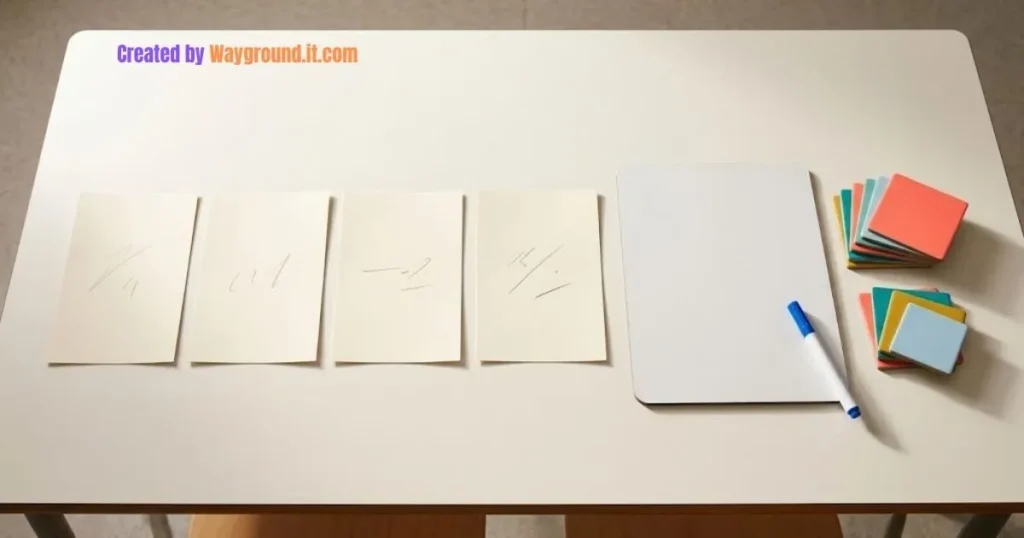
Give a group these four clues on separate cards:
- The number is greater than 20 and less than 40.
- It is a multiple of 3.
- It is odd.
- Its digits add to 9.
Shared goal: Identify the number and show how it fits every clue.
- Each student reads or explains a clue.
- The group lists possible numbers.
- Students eliminate candidates that fail a clue.
- Everyone checks the final answer independently.
The answer is 27. For example, 33 meets the first three clues but fails the digit-sum clue.
Keep the cards visible after the first reading. Remembering the wording should not become a hidden barrier to solving the mathematical problem.
2. Story reconstruction: defend the sequence
Prepare these sentence strips:
- Lina filled a pot with soil.
- She planted a bean in the soil and watered it.
- Days later, a shoot appeared.
- She moved the sprouted plant beside a sunny window.
Shared goal: Arrange the events and identify the clues that establish their order.
- Give each student a strip to examine.
- Ask them to describe its event before arranging it.
- Let the group propose an order.
- Have students explain two connections between events.
The shoot must appear before the plant is described as sprouted. Encourage students to point to the wording rather than rely only on what usually happens when gardening.
3. Rectangle design: solve the same problem differently
Give each group 12 equal square tiles and squared paper.
Shared goal: Build two rectangles using all the tiles, with no gaps or overlaps, and compare their perimeters.
- Students propose arrangements individually.
- The group builds and sketches two options.
- Each member checks one calculation or boundary count.
- Students explain what stayed the same and what changed.
A 3-by-4 rectangle has area 12 square units and perimeter 14 units. A 2-by-6 rectangle has the same area and perimeter 16 units.
Ask why equal area does not force equal perimeter. A rotated copy counts as the same rectangle for this challenge.
4. Describe and build: make instructions usable
Give a pair matching sets of three paper shapes. One student makes an arrangement behind a folder; the other reconstructs it from instructions without seeing the original.
Shared goal: Match the arrangement and improve one unclear instruction.
- Agree on the table’s “top” edge and a starting position.
- The describer gives one instruction at a time.
- The builder asks clarifying questions when needed.
- Compare the arrangements and swap roles.
“Put the triangle directly above the square, with its point facing the top edge” is more useful than “Put it over there.”
5. Solution repair: fix the reasoning together
Display this worked example:
“There are 4 bags with 6 marbles in each bag. There are 10 marbles altogether because 4 + 6 = 10.”
Shared goal: Correct the model, calculation, and explanation.
- Each student identifies the problem independently.
- One student sketches the bags while another checks the total.
- The group writes a corrected explanation.
- Each student answers a new equal-groups question alone.
The total is 24 marbles, represented by 4 × 6 or 6 + 6 + 6 + 6. Ask students to explain what each number represents.
For more low-tech formats, see our classroom review games without student devices.
How do you help every student contribute?
Give students an independent thinking moment, assign a useful responsibility, and rotate who explains the group’s answer. Participation can involve speaking, drawing, arranging materials, or writing. Keep responsibilities connected to the learning task so one child does not spend the whole activity distributing supplies while classmates do the reasoning.
Try three flexible roles: proposer, checker, and explainer. In a group of four, add a recorder who also asks for reasons before writing the answer.
Model two sentence starters before the first round:
- “I think this fits because…”
- “Can you show which clue supports that?”
When a student takes over, pause the group and ask each member to contribute one observation. When a student struggles, offer a diagram, read a clue aloud, or reduce unnecessary language demands while preserving the learning goal.
For language-focused follow-up, adapt the context and explanation prompts in our vocabulary games guide to your students’ reading level.
How do you know whether the game helped students learn?
Look separately at the group’s solution, the way students collaborated, and each learner’s understanding. A correct shared answer does not show who can solve a similar task independently. Finish with one related question and use the responses to decide whether students need another example, clearer explanation, or further challenge.
CMU’s group-assessment guidance distinguishes the finished product from group processes and individual learning. Adapt that distinction to a brief classroom check rather than importing a complex project-grading system.
After rectangle design, ask students independently to find the area and perimeter of a 2-by-5 rectangle. The answers are 10 square units and 14 units.
Record collaboration separately: did students use a partner’s clue, ask for clarification, or revise a mistaken explanation? Give specific feedback about the behavior you observed.
Avoid grading everyone from the team result alone or eliminating students after errors. Our formative vs summative assessment guide explains how the purpose of a check should guide what you do with its results.
What do teachers ask about cooperative classroom games?
Common questions concern group size, competition, inclusion, and materials. Start with the simplest version that gives students a reason to think together. Adjust the task when you see someone waiting without a role, and keep the learning goal visible when deciding whether a rule or resource is helping.
Do cooperative games need prizes?
No. Completing a shared puzzle or improving a design can provide a clear goal. If you add recognition, describe the reasoning or collaboration you noticed. Avoid rewards that make students blame a classmate for slowing the group down.
Can these games work in a large class?
Yes. Prepare repeated material sets and demonstrate the routine before groups begin. Start with a task that is easy to monitor, then circulate with one observation focus rather than trying to record every contribution at once.
How can I include students who avoid speaking publicly?
Offer thinking time and a written, drawn, or partner-rehearsed contribution before whole-class discussion. Give predictable opportunities to participate and follow established accommodations. A public performance should not become the only way to show reasoning or help the team.
Should groups race against one another?
They do not need to. These versions use shared completion criteria rather than a race. If you add a time window, allow enough time for explanation and clarification so finishing quickly does not replace the intended learning.
Can I adapt the games for older students?
Yes. Increase the complexity of the clues, texts, or constraints while keeping the rules familiar. For example, replace a number puzzle with algebraic conditions or ask students to reconstruct an argument using evidence from several short sources.
Begin with one shared challenge. Prepare the materials, model how to ask for a reason, and finish with an individual question. Use what you observe to improve the next round rather than adding more rules immediately.