
Useful vocabulary games for middle school ask students to explain, apply, and distinguish words—not just recognize a definition. Try a clue challenge for recall, a context detective game for meaning, or an example-sort activity for tricky concepts. Teach unfamiliar words first, then use games to practice them.
These five games suit grades 6–8 and work with paper, a classroom board, or a shared screen.
Which vocabulary games work well for middle school?
Choose a game that practices the part of word knowledge students need next. Clues support recall, context questions explore meaning in a sentence, and example sorting tests conceptual boundaries. Keep the vocabulary connected to current reading or subject content so students encounter the words again outside the game.
| Game | Practice focus | Materials | Response to look for |
|---|---|---|---|
| Explain without the word | Meaning and recall | Word cards | Accurate clue plus explanation |
| Context detective | Meaning in a sentence | Sentence strips | Interpretation supported by context |
| Example or non-example | Concept boundaries | Scenario cards | Classification with a reason |
| Word-family builder | Related forms and usage | Paper or board | Correct form in a sentence |
| Sentence repair | Precise word use | Prepared sentences | Correction that preserves meaning |
The What Works Clearinghouse’s adolescent literacy guide recommends explicit vocabulary instruction and rates the supporting evidence as strong. Games should give students practice with taught meanings, rather than replace explanation with guessing.
Vocabulary also belongs in science, math, and social studies. The Education Endowment Foundation’s secondary literacy guidance emphasizes how reading and language vary across subjects.
For example, “volume” can refer to sound level, a book, or three-dimensional space. Make the intended meaning clear before awarding points.
How do you run these five vocabulary games?
Use a short set of previously introduced words, explain the rules with one demonstration, and give everyone an individual thinking step. Then let students compare answers and discuss corrections. The activities below use simple scoring suggestions; you can run all five cooperatively without a leaderboard or individual devices.
1. Explain without the word
- Give one partner a target word, such as reluctant.
- Ask them to describe its meaning without saying the word or a related form.
- Have the listener identify the word and explain the clue.
- Swap roles with another card.
A useful clue might be: “You do not really want to try something, even though someone is encouraging you.”
Award a point for an accurate explanation, not just a correct guess. A clue such as “It starts with R” practices guessing rather than meaning.
2. Context detective
- Display a sentence containing a target word.
- Students independently write a meaning that fits.
- Partners identify which words support that interpretation.
- Reveal the intended meaning and discuss alternatives.
Prompt: “Water was scarce after weeks without rain, so the town restricted outdoor watering.”
Here, scarce means limited or insufficient in supply. The lack of rain and watering restriction provide evidence; they do not imply that all water has disappeared.
3. Example or non-example
- Teach a term and its defining features.
- Give students short scenario cards.
- Ask them to sort examples and non-examples independently.
- Let pairs defend one difficult choice.
For compromise, compare these situations:
- Two students each adjust their preferred meeting time to agree on a new one.
- One student insists on their original time, and the other accepts it unwillingly.
The first clearly illustrates both sides making concessions. Ask what would need to change in the second situation to make it a compromise.
4. Word-family builder
- Give students related forms, such as analyze, analysis, and analytical.
- Provide a sentence with a missing word.
- Ask students to choose the form and explain its role.
- Invite a new sentence using a different form.
Prompt: “The scientist’s ___ compared results from three trials.” The answer is analysis.
Follow with “The scientist will ___ the results,” which requires analyze. Discuss how related words contribute different grammatical roles rather than treating the activity as a spelling race.
Use established word families. Do not encourage students to attach arbitrary prefixes or suffixes and assume the result is a standard English word.

5. Sentence repair
- Show a sentence with an incorrectly used target word.
- Students explain the problem independently.
- Pairs rewrite the sentence to demonstrate the intended meaning.
- Compare more than one valid correction.
Prompt: “Nora was reluctant to enter the contest, so she signed up eagerly without hesitation.”
Ask students to resolve the contradiction. They could change reluctant to eager, or keep reluctant and revise the action to show hesitation.
How can you turn a game into a useful vocabulary lesson?
Build the lesson around a few words students will meet again, then move from explanation to practice and independent use. A game gives you one opportunity to inspect understanding. Finish with a fresh sentence or example, and revisit the vocabulary in later lessons instead of treating one successful round as mastery.
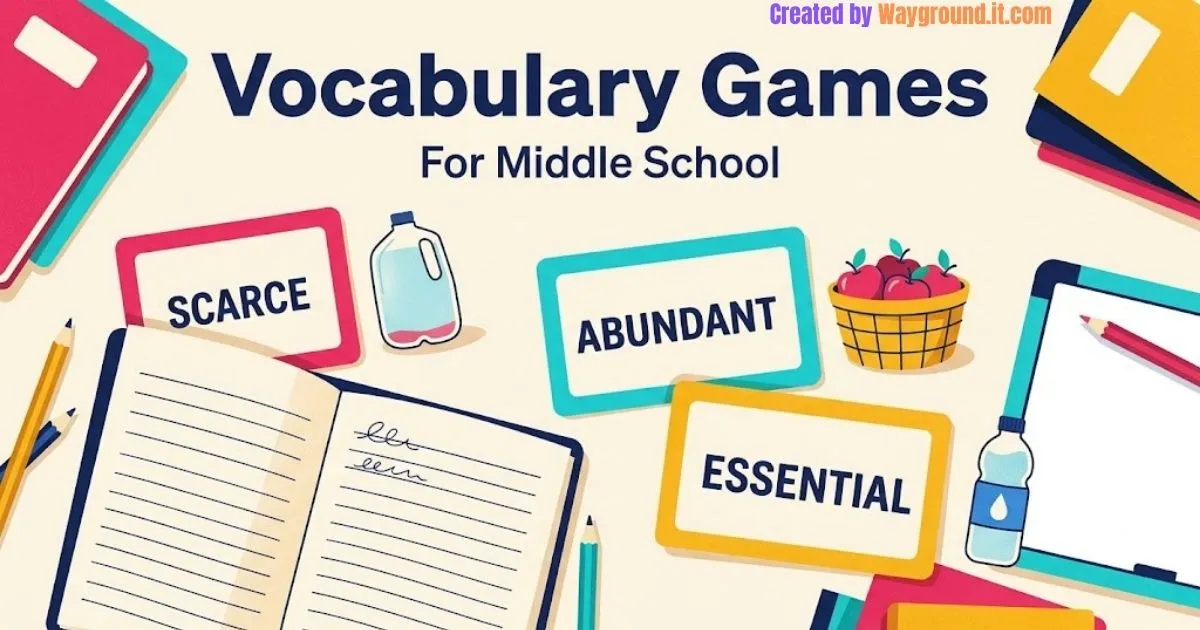
Here is a suggested sequence using scarce, abundant, and essential:
- Introduce the meanings. Explain each word and model a sentence. Contrast scarce and abundant; clarify that essential concerns necessity, not quantity.
- Run a context round. Use sentences about rainfall, food supplies, or school materials. Ask students to identify the clue supporting their answer.
- Discuss a tricky combination. Can something be both essential and scarce? Drinking water during a shortage provides a clear example.
- Collect independent writing. Ask each student to describe an essential item that might become scarce and explain the situation.
- Return to the words later. Change the context so students apply the meanings rather than repeat the same sentences.
Cognitive scientist Pooja Agarwal’s retrieval practice resources support low-stakes opportunities to recall earlier learning. For digital follow-up, our Wayground flashcards guide offers one tool-based option; paper cards can serve the same practice purpose.
What mistakes make vocabulary games less effective?
Vocabulary games become less useful when winning depends mainly on speed, confident speaking, or memorizing a card’s position. Look for accurate meaning and independent use instead. Reduce unnecessary barriers, correct misunderstandings promptly, and choose scoring rules that reward explanation without turning every practice attempt into a high-pressure performance.
Introducing too many unfamiliar words. Start with a manageable set from the current unit. Add more when students can explain the earlier words, rather than using a fixed number for every class.
Accepting vague sentences. “It was scarce” does not reveal much. Ask what was scarce and which detail shows that there was not enough.
Letting one student answer for a team. Have everyone write a choice or clue first. Rotate speakers and collect a short individual response after the shared activity.
Confusing language production with understanding. Offer a sentence starter, picture, oral explanation, or rehearsal time when appropriate. Follow students’ established accommodations and gradually ask for more independent expression.
Using a team score as the learning check. For an individual check, ask for a new example and read the explanation. You can organize such prompts using our quiz creation guide.
For more equipment-free formats beyond vocabulary, explore these classroom review games without student devices.
What do teachers ask about middle school vocabulary games?
Teachers often need activities that work across reading levels, subjects, and classroom equipment. Start with the word meaning you want students to use, then adjust the response format and support. These answers focus on practical choices rather than assuming that every group needs the same game or pace.
Which game needs the least preparation?
Sentence repair can use one target word and a deliberately flawed sentence on the board. Ask students to identify the problem and rewrite it. Prepare an explanation of the intended meaning before class so corrections remain focused.
Can these games support English learners?
Yes, with appropriate support. Model pronunciation and meaning, provide relevant visuals or sentence starters, and allow rehearsal before public speaking. Check subject knowledge separately when difficulty producing an English sentence could hide what a student already understands.
Should vocabulary games always be competitive?
No. Partners can work toward a shared explanation, or the class can improve a set of sentences together. If you use points, reward accurate reasoning and corrections without excluding students from further practice after a wrong answer.
Can I use the activities without technology?
Yes. Paper cards, pencils, and a classroom board cover all five formats. A shared screen is convenient for displaying prompts but unnecessary. Choose materials students can read and handle comfortably, with accessible alternatives where needed.
How do I check vocabulary retention?
Return to a word in a later lesson and ask for its meaning or use in a new context. Compare the response with earlier work. A correct answer immediately after discussion is useful evidence, but does not establish lasting retention.
Start with one activity and a few useful words. Teach the meanings, give every student a chance to respond, and finish with independent use. Build your next round around the explanations that still need attention.