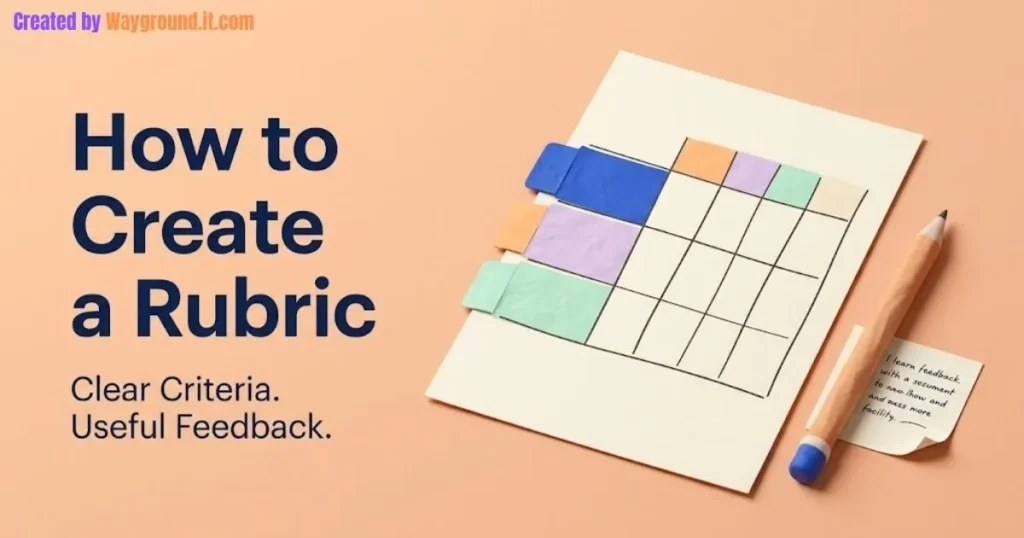

To create a rubric, identify the learning goal, choose the criteria you will assess, and describe what different levels of performance look like. Test the draft against sample work, revise unclear wording, and share it with students before they begin the assignment.
This guide includes a copyable rubric, a scored writing example, and practical checks for using the same expectations consistently. It is written for K–12 teachers and works with paper or a digital document.
What should a classroom rubric include?
A rubric should identify the features being assessed and describe the quality expected for each one. Include criteria, performance levels, and clear descriptions of the evidence that belongs at each level. Add points when needed, but keep the descriptions useful enough to guide feedback even without a total score.
Carnegie Mellon University’s rubric guidance identifies these core components and explains their role in making expectations explicit.
The format also matters:
- An analytic rubric gives separate judgments for individual criteria. Use it when students need specific feedback on several components.
- A holistic rubric gives an overall judgment of the work. It offers less detail about which component needs attention.
- A checklist records whether something is present or completed. It does not necessarily describe its quality.
How do you create a rubric step by step?
Build the rubric around the assignment’s learning goal rather than a list of everything you could mark. Define the successful performance first, then describe meaningful differences from it. Check the draft on sample responses before students use it, and explain how its scores connect to your school’s grading system.
1. State what students should demonstrate
Use an observable goal: “Make an inference about a character and explain it using relevant details from the passage.”
CMU’s assessment-alignment guidance explains why learning objectives, practice, and assessment should address the same skills.
2. Select a small set of distinct criteria
For this task, use three criteria: the inference, the selected evidence, and the explanation connecting them.
Avoid scoring the same weakness twice under nearly identical headings. For example, “support” and “evidence quality” may overlap unless you clearly distinguish what each measures.
3. Describe successful work before weaker work
Write the target in plain language. Instead of “Excellent reasoning,” use “Explains how each selected detail supports the inference.”
Then describe what is missing at the other levels. Cornell’s rubric guidance recommends observable indicators and distinctions between performance levels, rather than vague labels such as “interesting.”
4. Set the scoring rule
Decide whether all criteria matter equally. In the sample below, each row earns 0–3 points, giving a maximum of 9.
Explain that scale before the task. Do not assume that 6/9 should automatically become a particular letter grade; use your school’s published grading approach and the meaning of the descriptors.
5. Test and explain the draft
Apply it to a few sample responses. If two colleagues place the same work at different levels, compare the evidence they noticed and clarify the wording.
Then score an example with students. Cornell also recommends student practice and feedback as part of improving a rubric; students need to understand the descriptions before using them independently.
What does a complete rubric look like in practice?
A useful sample pairs the rubric with the exact assignment it assesses. That lets you check whether the criteria match the task and whether the levels separate meaningful differences in performance. The original reading task below is designed for a short upper-elementary or middle-school response and includes a scoring demonstration.
Copyable task and passage
Passage: “The class had already lined up for recess when Owen noticed that Amir’s folder had opened. Papers lay beneath two desks. Owen stepped out of line, helped collect them, and handed Amir a spare clip before joining the class.”
Task: What can you infer about Owen? Write a paragraph using two details from the passage and explain how each supports your inference.
Nine-point reading-response rubric
| Criterion | 3 — Meets the target | 2 — Partly meets the target | 1 — Limited evidence | 0 — No relevant evidence |
|---|---|---|---|---|
| Inference | Makes a clear inference supported by the passage. | Makes a plausible inference, but its wording is unclear. | Gives a trait or claim the passage does not adequately support. | Provides no identifiable inference. |
| Text evidence | Accurately uses two relevant passage details. | Accurately uses one relevant detail; another is missing or unsuitable. | Attempts evidence, but details are inaccurate or irrelevant. | Provides no passage details. |
| Reasoning | Explains how each selected detail supports the inference. | Explains the connection for one detail, or gives a general link without explaining both. | Repeats details or the inference without explaining their connection. | Provides no relevant explanation. |
Scoring rule: Select one level per row and add the points. Record one specific next step beside the score.
Scope: This rubric assesses inference and support. If sentence conventions are a separate learning goal, teach them and add a clearly defined criterion before assigning the task.
Worked scoring example
Sample response: “Owen is considerate. He left the recess line to help collect Amir’s papers and gave him a spare clip. These actions helped his classmate.”
Using this rubric, the response earns:
- Inference: 3. “Considerate” is a clear, supported interpretation.
- Text evidence: 3. The response accurately includes two relevant actions.
- Reasoning: 2. It gives a general connection but does not explain what each action reveals.
Total: 8/9. A useful next step is: “Explain how leaving the line shows consideration, then explain how the clip could help Amir.”
A stronger revision might add that Owen interrupted his own plans to help and provided something that could keep the papers together. That improves the reasoning rather than merely lengthening the paragraph.
If several students need the same follow-up, use a brief check such as a Google Forms exit ticket to collect another explanation after reteaching.
How do you avoid unfair or confusing rubric scores?
Keep each judgment tied to evidence in the work and criteria students received in advance. Separate the intended learning from unrelated presentation preferences, and use the same interpretation of each descriptor across submissions. When a response falls between levels, explain the evidence behind your decision instead of relying on an overall impression.
Do not hide extra expectations. If citations, diagrams, or oral explanations matter, state that in the task. Avoid deducting points for an unstated preference after students submit.
Do not treat the total as the whole feedback message. Two students with the same score may need different revisions. Identify the row that will make the biggest difference next.
Keep access needs separate from the target skill. Follow established accommodations and use appropriate response formats. If typing is not being assessed, difficulty typing should not silently become part of the score.
Decide how the rubric will be used. It can support draft feedback or evaluation of final work. Our formative vs summative assessment guide explains that distinction.
For a group task, distinguish the shared product from individual learning. The follow-up questions in our cooperative classroom games guide show one way to check both.
What do teachers ask about creating rubrics?
Teachers usually need to decide how much detail to include, when to share the rubric, and whether to attach points. Start with one assignment and a manageable set of criteria. The answers below focus on practical classroom choices rather than assuming that one scoring scale fits every subject or school.
How many criteria should I use?
Use only the criteria needed to judge the learning goal. A short paragraph might need three, while a complex project may need more. Remove a row if it duplicates another or measures something you have not asked students to demonstrate.
Should students see the rubric before starting?
Yes. Share it with the assignment and discuss an example so the wording has a clear meaning. Invite questions before students begin, and avoid adding new scored expectations after they have completed their work under the original instructions.
Can I use a rubric without points?
Yes. You can mark the description that fits the work and identify a revision step without calculating a total. This can be useful during drafting, when the immediate purpose is improving a specific part of the response.
Can I reuse the same rubric?
Reuse it when the new task assesses the same skills at the same expected level. Check every descriptor first. A rubric for a supported character inference will not automatically fit a science explanation or an oral presentation.
Do I need a rubric for every quiz question?
No. A fixed-answer question may need only an answer key, while an extended explanation benefits from clearer quality criteria. Choose the scoring method that captures the intended evidence without adding more marking work than the task requires.
Start with one assignment. Define its goal, draft a few distinct criteria, and test the descriptions against sample work. Share the rubric early, then use it to give students a concrete next step.