
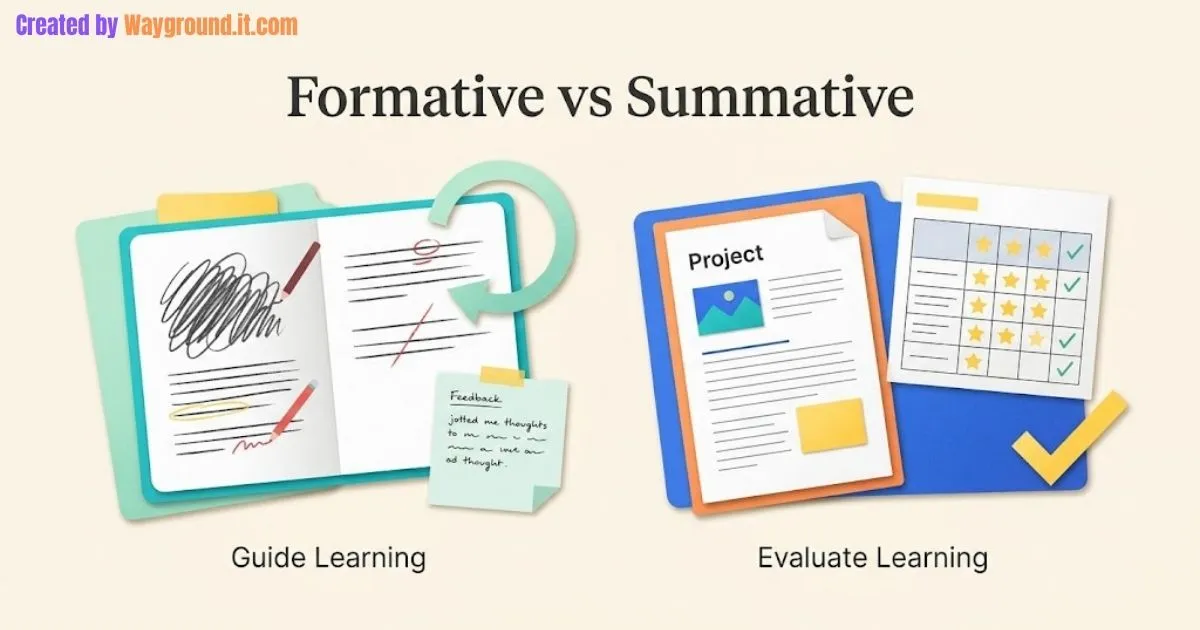
Formative assessment uses evidence of learning to guide teaching and practice while learning is developing. Summative assessment evaluates achievement against criteria at a defined point, such as the end of a unit. The difference is mainly purpose, not whether students use a quiz, essay, project, or digital platform.
This guide explains the distinction for K–12 teachers, shows how both approaches fit into one unit, and offers practical examples you can adapt without buying another classroom tool.
What is the difference between formative and summative assessment?
Formative assessment helps identify the next teaching or learning step. Summative assessment judges what students have achieved against an expected standard. Timing often differs, but timing alone does not define the category: an end-of-lesson response can inform tomorrow’s instruction, while a short quiz can contribute to a final achievement judgment.
Carnegie Mellon University’s Eberly Center describes formative assessment as generally low stakes and summative assessment as often higher stakes. It also notes that summative results can inform later learning.
| Question | Formative use | Summative use |
|---|---|---|
| Main purpose | Decide what needs attention next | Evaluate achievement against criteria |
| Typical timing | During an ongoing learning sequence | At a defined assessment point |
| Common examples | Draft feedback, diagnostic questions, exit responses | Unit tests, final projects, performances |
| Role of results | Adapt instruction or improve work | Record or communicate demonstrated achievement |
Think about a writing assignment. Comments on a draft can help a student strengthen the argument before submission; evaluating the completed essay against the agreed criteria serves a different purpose.
How do you plan both types in the same unit?
Start with what students should be able to do, then decide what evidence would demonstrate it. Plan smaller checks before the final task and reserve time to respond to them. This creates a connected sequence in which practice, feedback, and the final assessment address the same learning goals.
1. Define an observable learning goal
Replace “understand graphs” with something you can examine: “interpret a bar graph and support a comparison using its values.”
2. Choose a suitable final task
Ask students to interpret an unfamiliar bar graph, compare two categories, and justify a conclusion. Ensure the labels and values are readable, and avoid unnecessary background knowledge that could obscure the graph-reading skill.
This follows the principle of aligning assessments with learning objectives and instruction: the task should measure what students were meant to learn and had opportunities to practice.
3. Plan checks that expose different mistakes
Use one question about the scale, another about comparing values, and a third about supporting a statement with evidence.
A single overall score can hide those differences. Plan to look at the response to each question, especially when one skill is necessary for the next lesson.
4. Decide how you will respond
If students misread intervals, revisit the axis before assigning more comparisons. If they identify values correctly but make unsupported claims, model how to connect a conclusion to a number.
You can organize these checks using a quiz creation workflow or prepare them on paper. Choose the method that makes responses easiest to inspect.
5. Make expectations clear before submission
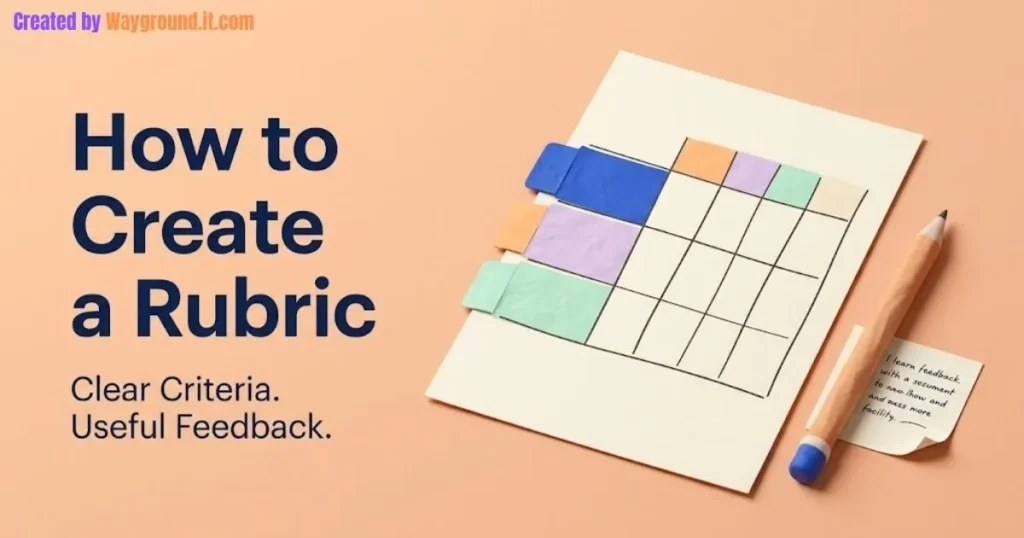
For an extended response, share what counts as accurate interpretation, relevant evidence, and clear explanation. CMU’s rubric guidance explains how criteria, performance descriptions, and levels make expectations explicit.
What do these assessments look like in a real lesson task?
The distinction becomes clearer when you follow a specific learning goal through practice, feedback, and a final task. The examples below provide classroom-ready prompts and possible teaching responses. They illustrate assessment planning; the useful decision depends on the answers your own students produce, not on an assumed class result.
Math: comparing two purchase options
Practice prompt: Three notebooks cost $6 at one store. Five notebooks cost $9 at another. Which has the lower price per notebook? Show the calculation.
The unit prices are $2 and $1.80. If students choose the $6 pack only because its total is lower, review how unit rates support a fair comparison.
Final task: Compare two new purchase options and explain the choice using unit prices. Use different quantities so students must apply the method rather than repeat the practice answer.
English language arts: evidence that supports a claim
Practice prompt: Give students a short passage and a claim about a character. Ask them to select one sentence that supports the claim and explain the connection.
Final task: Ask for a paragraph about a new passage, using criteria for a defensible claim, relevant evidence, and explanation. Let students practice those components before expecting an integrated response.
Science: separating observations from explanations
Practice prompt: A cold glass develops droplets on its outside. Ask students to distinguish the observation from an explanation of where the water came from.
If a response suggests water passed through the glass, address that idea directly. Explain how water vapor in the surrounding air can condense on a sufficiently cold surface.
Final task: Present a different condensation example and ask students to explain it using the same scientific concept. Keep the new context understandable without adding unrelated reading demands.
For short practice rounds before an independent check, try classroom review games without student devices. Collect an individual response afterward so the team’s answer does not stand in for each student’s reasoning.
Which assessment mistakes should teachers avoid?
Avoid treating a format, score, or software setting as proof that an assessment serves its purpose. Check whether the task measures the intended learning, whether students can access it, and whether the results lead to an appropriate action. A polished assessment can still produce evidence that is difficult to interpret.
Collecting answers without planning a response
Before a quick check, finish this sentence: “If students show this misunderstanding, I will…” If no answer comes to mind, narrow the question or reconsider why you are collecting it.
The Education Endowment Foundation’s feedback guidance for ages 5–18 emphasizes feedback principles rather than a simple preference for written or verbal comments. More marking is not automatically more useful feedback.
Give students a specific action, such as revising an unsupported claim, and time to complete it.
Using unrelated difficulty as a hidden test
When assessing mathematical reasoning, unusually complex wording may introduce a separate reading barrier. Follow established accommodations and check that the response format permits students to demonstrate the intended skill.
If the goal is written argument, however, writing is part of the evidence. Adjust access thoughtfully without losing sight of what the task measures.
Reading only the total score
Two students with the same total may need different support. One may misunderstand the central concept, while another makes isolated calculation errors.
When using a digital platform, inspect individual questions and explanations. Our guide to Wayground reports explains how to review results in that tool; use the evidence to choose a follow-up rather than relying only on a leaderboard.
Making grading rules unclear
Tell students which work provides practice and which contributes to reported achievement. Apply your school’s grading and reassessment policies consistently, and explain the criteria before students complete the task.
What do teachers ask about formative and summative assessment?
Teachers often need to classify quizzes, homework, and projects when planning a unit. Begin with the intended decision, then inspect the task and follow-up. These questions address common planning uncertainties without assuming that every school uses the same grading system, assessment schedule, or reporting requirements for student achievement.
Can a quiz serve both purposes?
Yes. A quiz might contribute to an achievement judgment while also revealing what to revisit. Tell students how it will be used, and make the follow-up specific instead of assuming that returning a score provides enough guidance.
Should I grade every formative activity?
Consider whether a grade is needed for the decision you are making. For a brief practice check, identifying the error and giving a next step may be more useful than assigning points; follow your school’s requirements.
Is homework automatically formative assessment?
No. Decide what evidence the homework will provide and how you will use it. For independent practice, inspect errors and plan a response; also consider whether outside help makes the submission an uncertain measure of independent understanding.
How often should I check understanding?
Place checks where the answer could change your next teaching move. That might be before introducing a dependent skill or after discussing a misconception. Avoid adding questions simply to meet a fixed count that does not fit the lesson.
Do I need a digital assessment tool?
No. Paper responses, conversations, drawings, and observed performances can provide useful evidence. Choose technology when it solves a practical problem, such as organizing responses, and keep an alternative available when access or the task calls for it.
Plan the decision before the assessment. Choose one upcoming unit, identify the final evidence you need, and add a focused check where students are likely to struggle. Leave time for a response so assessment helps shape the learning sequence as well as describe its outcome.