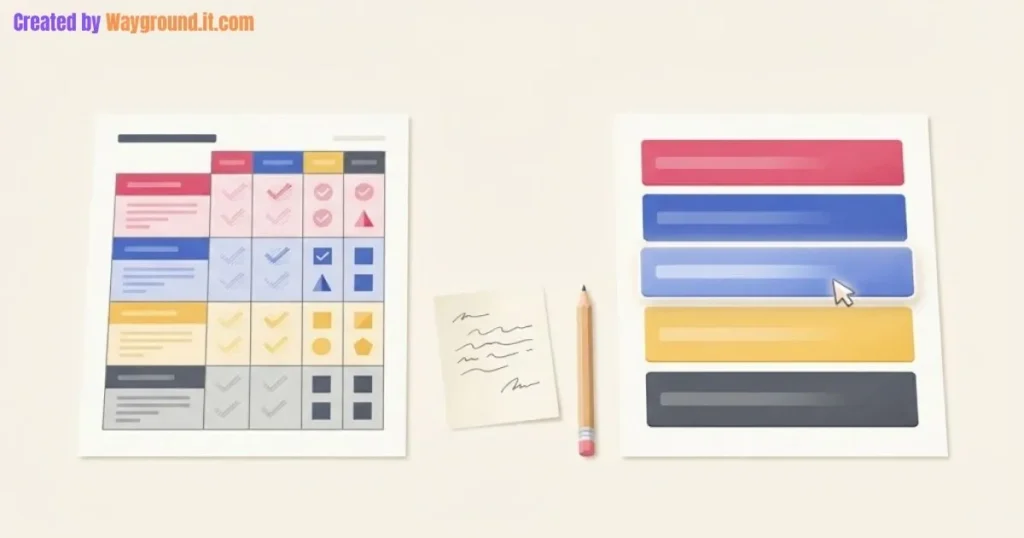


An analytic rubric evaluates separate criteria, such as evidence and reasoning. A holistic rubric evaluates the work as a whole and assigns one overall level. Choose analytic scoring when students need to see which component to improve. Choose holistic scoring when an overall judgment fits the assessment purpose.
Both formats can use clear standards, and both require teacher judgment. The difference is how they organize that judgment and how much detail the resulting score gives students.
Below, one classroom task appears in both formats, followed by a worked scoring example. You can compare the feedback each version makes possible before choosing one for your own assignment.
What is the difference between analytic and holistic rubrics?
An analytic rubric separates the task into criteria and describes performance levels for each one. A holistic rubric combines the important qualities into descriptions of overall performance. Students receive a profile of strengths and gaps with analytic scoring, while holistic scoring provides a single judgment of the complete response.
The University of Illinois Chicago’s rubric guidance distinguishes these formats and discusses their different feedback uses. The key choice is whether you need to report performance separately for each criterion.
| Feature | Analytic rubric | Holistic rubric |
|---|---|---|
| Unit of judgment | Each criterion | The complete performance |
| Result | Separate levels or scores, sometimes totaled | One overall level or score |
| Feedback detail | Shows which components need attention | Usually needs comments to explain specific gaps |
| Useful when | Planning revision or tracking distinct skills | Making an overall judgment against a defined standard |
| Main limitation | Too many criteria can make scoring cumbersome | One level can hide an uneven performance |
A checklist answers a different question: whether an element is present or completed. “Includes evidence” is less informative than a description of whether that evidence is accurate and supports the conclusion.
What does the same task look like in both formats?
Comparing both rubrics against one task makes the difference easier to see. Keep the learning goal and expected evidence the same, then change how you report performance. The original example below assesses a short explanation of numerical data rather than grammar, presentation, or general writing style.
The classroom task
Use this invented data set for an upper-elementary or middle-school practice task:
On Monday, a class collected 18 empty plastic bottles for recycling. On Tuesday, it collected 12. On Wednesday, it collected 15.
Write two or three sentences explaining which day had the highest collection. Include the totals for all three days and explain how much higher the largest collection was than each of the others.
The target is a correct conclusion, accurate use of the supplied numbers, and correct numerical comparisons. The data describe bottles collected; they do not establish how many bottles students used or whether a recycling campaign caused a change.
Analytic rubric example: score each criterion
| Criterion | 2 — Meets the target | 1 — Partly meets the target | 0 — Not demonstrated |
|---|---|---|---|
| Conclusion | Clearly identifies Monday as the highest collection. | Identifies Monday, but the wording makes the conclusion uncertain. | Gives an incorrect conclusion or none. |
| Data accuracy | Accurately states the totals for all three days. | Accurately states one or two daily totals; another is missing or incorrect. | Provides no accurate daily totals. |
| Comparison | Correctly explains both differences: 6 more than Tuesday and 3 more than Wednesday. | Explains one difference correctly; the other is missing or incorrect. | Explains neither difference correctly. |
Select one level per row. If a total is useful, this example allows up to six points, with equal weight for each criterion.
Keep the separate results alongside any total. Two responses worth four points could have different weaknesses and require different revisions.
Holistic rubric example: judge the complete explanation
Level 3 — Complete explanation: Clearly identifies Monday, accurately states all three daily totals, and correctly explains both numerical differences.
Level 2 — Mostly complete explanation: Identifies Monday and gives a largely accurate account of the data, but one part is missing or incorrect, such as one comparison or one daily total. The overall explanation remains understandable.
Level 1 — Partial explanation: Shows some relevant understanding, such as the correct day or an accurate total, but substantial omissions or errors prevent a complete explanation of the comparison.
Level 0 — No relevant demonstration: Provides no accurate, relevant explanation of the supplied data.
Choose the description that best matches the whole response and note the evidence supporting that decision. If a response does not fit the descriptions clearly, use it to identify wording that needs clarification before applying the rubric broadly.
How would you score one response with each rubric?
The same response can receive separate criterion scores and a single overall level without either judgment being contradictory. The scales describe performance differently. Use them to communicate the evidence they were designed to capture, and avoid assuming that their numbers translate directly into equivalent percentages or letter grades.
Consider this constructed student response:
“Monday had the highest collection with 18 bottles. Tuesday had 12 and Wednesday had 15. Monday had 6 more than Tuesday.”
With the analytic rubric, it earns:
- Conclusion: 2/2. Monday is clearly identified.
- Data accuracy: 2/2. All three totals are correct.
- Comparison: 1/2. The difference from Tuesday is correct, but the Wednesday comparison is missing.
The total is 5/6, with the comparison row identifying the revision needed.
With the holistic rubric, the response fits Level 2: it is largely accurate and understandable, but one required comparison is missing.
Both can lead to the same useful comment: “Add how many more bottles were collected on Monday than on Wednesday.” The analytic rubric makes the location of that gap visible in the score; the holistic rubric relies more on the accompanying explanation.
Neither 5/6 nor Level 2 should automatically become a letter grade. Apply the grading policy and interpretation established for the assignment.
When should you choose each type?
Choose analytic scoring when separate skills need separate feedback, especially when students will revise their work. Choose holistic scoring when the overall quality of an integrated performance is the decision you need. Neither format guarantees faster, fairer, or more accurate marking without clear descriptions and consistent use.
Choose analytic when the next step depends on the criterion
A reading response might contain accurate evidence but weak reasoning. An oral presentation might explain ideas clearly while using an ineffective structure.
Separate criteria help you identify those differences. They also give students a focused self-review task: check the evidence, improve the reasoning, or reorganize the explanation.
Our guide to creating a rubric covers how to select criteria and write performance descriptions when you need to build one from scratch.
Choose holistic when the overall performance is the priority
A holistic rubric may suit a short response or an integrated performance when separate subscores are unnecessary. You still need descriptions that explain what distinguishes the levels.
It can involve fewer scoring decisions, but difficult borderline responses still take attention. Add a brief comment when students need to know what would improve the work.
The format also does not determine whether an assessment is formative or summative. Either can guide revision or support a final evaluation; our formative vs summative assessment guide explains that difference in purpose.
How do you keep either rubric clear and consistent?
Test the rubric on sample work before using it for consequential scoring. Check whether the descriptions separate meaningful differences and whether different readers interpret them similarly. Share the expectations with students early enough to use them, then keep scoring tied to the stated task rather than unstated preferences.
Carnegie Mellon’s guidance on creating and using rubrics identifies criteria, performance descriptions, and levels as core components. Cornell’s rubric guidance also recommends testing rubrics and helping students understand their use.
- Check alignment. Include only qualities that belong to the learning goal. Do not quietly score handwriting when the task assesses data interpretation.
- Replace vague labels with evidence. “Excellent” alone does not tell students what successful work contains.
- Try uneven responses. Include examples with strong conclusions but weak explanations, not only uniformly strong or weak work.
- Compare scoring decisions. If colleagues disagree, discuss the evidence and clarify descriptors before grading the full set.
- Give a usable next step. A score is more helpful when students know what to revise and have an opportunity to do it.
For your next assignment, decide what students need from the result. If they need a breakdown, start with an analytic rubric. If an overall judgment is sufficient, draft a holistic one—and test whether its descriptions capture the work you actually expect.